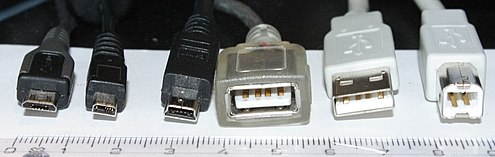
The Universal Serial Bus (USB) was created in the mid-1990s by a consortium of companies including Compaq, IBM, DEC, Intel, Microsoft, NEC, and Nortel. The aim was to dramatically simplify the way peripherals like mice, keyboards or printers connect to computers.
Before USB, computers used parallel and serial ports for data transfer. These early ports came with multiple technical challenges. They were large in size and often required shutdown and restart of the PC to connect or disconnect a device. Also, each port type used different protocols for communication.
USB was introduced as an answer to these problems. Its first iteration USB 1.x was released in 1996. It supports two data rates: 1.5 Mbps (low speed) for devices such as keyboards and mice; and 12 Mbps (full speed) for higher-speed devices such as printers or scanners.
In April 2000, USB 2.0 (Hi-Speed USB) specification was introduced by the same team of companies. It increased the data transfer rate to 480 Mbps which made it quite favorable for high-speed data transfer activities.
The next major development came with USB 3.x – Superspeed USB – which was announced in November 2008 but took until January 2010 for products like storage devices that use ‘Superspeed’ specification to reach the market. The speeds ranged from 5 Gbps (USB 3.0),10 Gbps (USB 3.1 Gen 2), up to a staggering speed of up to 20 Gbps (USB3.2).
Meanwhile, the physical design of USB connectors also evolved over time – from Type-A and Type-B connectors with their mini/micro versions dominating early standards – towards Type C connector with its slim profile and reversible plug orientation which is now widely used today.
In conclusion, throughout its history that spans over decades now, USB has been instrumental in making the process of connecting peripherals to a computer more straightforward, faster and efficient. Today, it’s hard to imagine a world without USB connectivity as it has become an integral part of almost every electronic gadget that we use.